

Designing roofing systems for height-constrained buildings
By Versico Roofing Systems.
Learn how utilizing Vacuum Insulated Panels (VIPs) can help roof designs meet energy codes, stay within height limits and deliver durable, efficient roofing systems.
In today’s commercial construction landscape, not every project allows for unlimited vertical space. Height-constrained roofs — often found in dense urban areas or developments governed by strict building codes — require a more strategic approach to design. When vertical clearance is limited, every component of the roofing system must be carefully planned to balance performance, compliance and constructability.
What are height-constrained roofs?
A height-constrained (or height-restricted) roof refers to any roofing system where the total allowable elevation above the deck is capped. Local zoning regulations, building codes or architectural limitations often dictate these restrictions, impacting both the roof assembly and any rooftop equipment.
Despite these limitations, buildings must still meet modern energy efficiency standards. This creates a key challenge: achieving required insulation performance without exceeding height limits.
Key challenges in limited-height roof design
Designing within tight vertical constraints affects multiple aspects of a project. Common obstacles include:
- Roof-access doors that limit assembly height
- Windows positioned close to the roofline
- Fixed drainage points like through-wall scuppers
- Equipment curbs that may need elevation adjustments
- Parapet walls with limited flexibility
Each of these factors reduces design freedom and can complicate insulation strategies.
New construction: Designing with constraints in mind
New construction projects offer the advantage of proactive planning. By addressing height restrictions early in the design phase, teams can align structural and roofing decisions from the outset.
High-performance, low-profile insulation systems are often specified to meet energy codes without adding unnecessary thickness. The most successful projects take a coordinated approach — ensuring architects, engineers and roofing professionals work together to avoid conflicts later on.
Re-roofing projects: Navigating existing limitations
Re-roofing presents a different set of challenges. Contractors must work within the confines of an existing structure, which is often already close to its maximum allowable height.
Adding insulation in these scenarios can trigger additional modifications, such as:
- Raising equipment curbs
- Extending parapet walls
- Adjusting drainage systems
These changes can quickly increase project complexity, cost and timelines.
Common pitfalls to avoid
- Installing additional insulation without verifying height restrictions
- Overlooking parapet and flashing height requirements
- Assuming roof overlays are always a viable solution
The role of Vacuum Insulated Panels (VIPs)
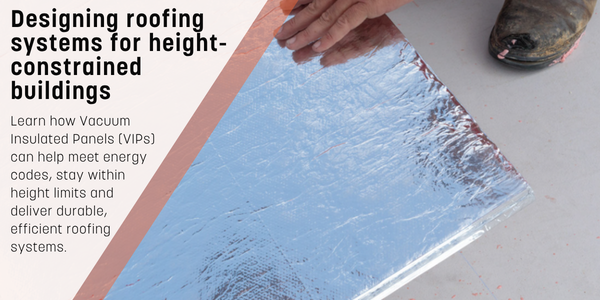
Vacuum Insulated Panels (VIPs) are a high-performance solution for projects where thickness is a critical constraint. Rather than being used alone, VIPs are integrated into layered roofing systems designed to protect them and maximize durability.
A typical assembly includes:
- Roofing membrane (TPO, PVC or EPDM)
- Protective cover board (high-density polyiso)
- VIP insulation layer
- Additional cover board
- Structural roof deck
This layered approach ensures the VIPs remain protected while delivering exceptional thermal performance.
Where VIPs deliver the most value
VIPs are especially effective in areas where traditional insulation falls short due to space limitations, including:
- Low parapet conditions
- Door thresholds and rooftop access points
- Retrofit projects with fixed elevations
- Buildings with zoning or aesthetic restrictions
Because VIPs offer extremely high R-values in a thin profile, they provide solutions where conventional materials cannot.
Hybrid insulation strategies
Most commercial roofing systems incorporate a hybrid approach rather than relying solely on VIPs. Typically:
- VIPs are used in critical, space-constrained areas
- Polyiso insulation is used in less restrictive zones
This combination balances cost, performance and constructability.
Designing around VIP limitations
VIP panels cannot be cut, which requires careful planning. A buffer zone — typically 4 to 6 inches — is maintained around penetrations and edges. Designers place full-size panels where possible and fill remaining gaps with polyiso insulation.
Understanding R-value calculations
The overall thermal performance of a hybrid system is calculated as a weighted average based on material coverage.
- Polyiso insulation: approximately R-5.7 per inch
- VIP insulation: approximately R-66 per inch
For example, if 90% of a roof uses VIPs and 10% uses 1-inch polyiso, the combined system can achieve an average R-value of around R-60 — demonstrating the efficiency of this approach.
Final thoughts
Height-constrained roofing projects demand a different level of planning and precision. Whether for new construction or retrofit applications, success depends on selecting the right materials, coordinating across disciplines and designing with limitations in mind.
By leveraging high-performance, low-profile insulation solutions, project teams can meet energy codes, stay within height limits and deliver durable, efficient roofing systems — even in the most restrictive environments.
Learn more about Versico Roofing Systems in their Coffee Shop directory or visit www.versico.com.
Recommended For You

Challenging leaders to rethink growth
Read More ...
Check out IIBEC’s new member experience!
Read More ...
Ignite your business at the 2027 Lightning Protection Institute show!
Read More ...
UP TO THE MINUTE





Comments
Leave a Reply
Have an account? Login to leave a comment!
Sign In