
Learning the ropes of low-slope roofing for your steep-slope business
By MuleHide.
The differences between low-slope and steep-slope roofing run deeper than most realize.
If you’ve spent your career walking steep roofs, stepping onto a low-slope system can feel like entering a whole new trade. The materials change. The methods shift. Even the vocabulary gets flipped. “Flat” doesn’t mean flat, waterproofing takes center stage and the line between commercial and residential gets blurry fast. In this first of a five-part series from MuleHide, we break down the fundamentals, because understanding what low-slope roofing really is and isn’t, is the first step to doing it right.
What is low-slope roofing?
So, what is a low-slope roof and how does it differ from a steep-slope roof?
Low-slope, not no-slope
A low-slope roof has a 2/12 pitch or less, meaning that, for every 12 inches of horizontal run, the roof rises 2 inches or less.
Low-slope roofs are often called “flat roofs,” but no roof is truly flat. Water is one of the most destructive forces on Earth (it created the Grand Canyon, after all) and must be removed from a roof as quickly as possible. Every roof must, therefore, have slope to provide positive drainage. On a low-slope roof, it can come via the building’s structure, tapered insulation or a combination of the two.
Waterproof vs. water-shedding
Low-slope roofs are waterproof, though still intended to incorporate drainage, while steep-slope roofs typically shed water at a faster rate. In a low-slope roof, the roof covering, along with the sealants used for flashing and seaming, prevent water from entering the roofing system. Steep-slope roofs rely on the gravity provided by their greater pitch to quickly remove water from the roof’s surface.
Not to be confused with “commercial roof”
Many people use the terms “low-slope roof” and “commercial roof” interchangeably, but they are not synonymous. “Low-slope” refers to a roof’s pitch, while “commercial” describes the type of building the roof covers. Many commercial buildings – churches, hotels, schools, medical facilities, restaurants, retail establishments and more – have steep-slope roofs. And low-slope roofs can be found on many residential buildings, particularly in the arid Southwest where drainage is not as big a concern.
Materials used
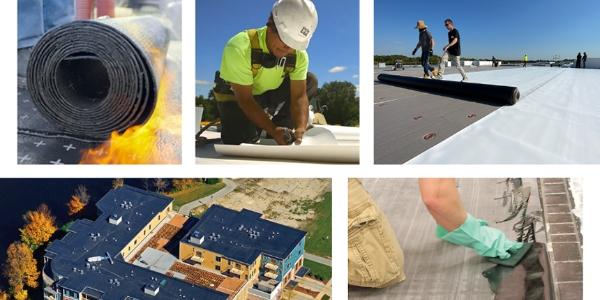
Low-slope roofs typically feature a single-ply membrane, sheet or rolled goods or layers of asphalt. Steep-slope roofs are usually constructed with shingles, tiles or metal panels.
A brief history of low-slope roofing
Built-up roofing (BUR) systems are the oldest type of low-slope roof still used today. Early BUR systems were constructed by applying multiple layers of tar-soaked felt and adding a top layer of gravel mixed into hot tar. In the 1870s, asphalt replaced tar.
Modified bitumen (mod bit) systems were introduced in the 1970s. Still asphalt-based, they introduced rubberized modifiers to the sheet goods, which increased their flexibility and provided an updated take on BUR systems that was faster and easier to install.
Single-ply roofing systems began appearing in the United States in the 1960s. EPDM and PVC systems were first, their popularity fueled by the limited supply and increased cost of high-quality roofing asphalt. TPO arrived in the United States in the early 1990s and is now the dominant low-slope roofing material.
Fluid-applied roofing systems – roof coatings – have been used to return aging roofs to near-new condition since the 1950s. Continuous improvements in performance and ease of application over the decades have helped them become the fastest-growing segment of the low-slope roofing industry today.
We’ll dig into each of these roof covering types later in this series, discussing their composition and the characteristics that set them apart. But they are just the final component in a multi-part system.
Next up, we’ll dissect a low-slope roofing system layer by layer and explain the vital role each plays in a roof’s performance. We’ll also take a deeper dive into the first two of those layers – the roof deck and insulation and cover boards.
Original article and photo source: MuleHide
Learn more about MuleHide Products in their Coffee Shops Directory or visit www.mulehide.com.
Recommended For You
Get Trained to Become a Stormseal Installer Today!
Read More ...
Go all in on irrigation
Read More ...
Master the elements through the science of performance
Read More ...
UP TO THE MINUTE






Comments
Leave a Reply
Have an account? Login to leave a comment!
Sign In