
Project profile: 太行新宇美术馆 - Tàixíng Xīnyǔ Art Museum
By Emma Peterson.
From its mountain-inspired rooflines to its use of reclaimed local stone, this museum showcases how thoughtful design can create a powerful dialogue between regional history, natural landscapes and modern architecture.
In the northernmost part of 河南 (Hénán) province is town 林州 (Línzhōu). Línzhōu is known for its proximity to the stunning 太行 (Tàiháng) mountains, which are being considered for status as a UNESCO World Heritage site due to the area’s “special relics of geology, stratum, rock, structure, sedimentation, ancient extinct life fossil and hydrology, as well as the unique 嶂石岩 (Zhàngshíyán) landform (red rock canyons) of Tàiháng Mountain.”
With this type of stunning backdrop, it is no wonder that art has always had a home in Línzhōu. The history of art in Línzhōu dates back to 郭熙 (Guō Xī), one of the most important landscape artists in Chinese history who lived from 1020 to 1090. Specifically, in the painting theory and book 林泉高致 (Línquán Gāozhì), which was created based on Guō Xī’s work, there is a saying that refers to the Tàiháng and Línzhōu areas, “太行枕華夏,而面目者林慮.” This roughly translates to “Tàiháng rests on China, and the face is Línlǜ.”
Today, students are still listening to this theory and coming to Línzhōu to paint. So much so that the area has become nicknamed the 中国画谷 (Zhōngguóhuà Gǔ) or “Chinese Painting Valley.” With such a reputation related to the arts, it is no wonder that the 太行新宇 (Tàixíng Xīnyǔ) art museum would find a home in the area.
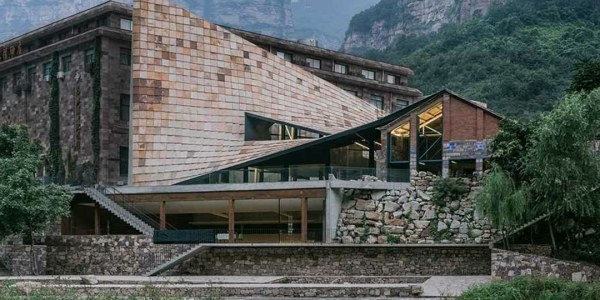
 Built in 2022, this museum was designed by the 王冲 (Wángchōng) architect firm and sits at “the corner of the bridge at the entrance of the town” on a triangular plot between the base of the mountains and the bank of the 苍溪 (Cāngxī) river. When asked about the inspiration behind their design, the Wángchōng team highlighted a connection to the art housed inside the space, saying, “Traditional Chinese landscape paintings try to describe the paths into the mountains layer by layer, which inspired us to design layers of retreats and zigzag mountaineering paths in the site adjacent to the water and back of the mountain.”
The result of this goal is a stunning museum that “seems to grow out of the mountain environment, echoing organically, as if it has been standing and growing for many years, with a strong sense of place and its wildness can touch the context of Tàiháng,” according to ArchDaily. This effect was created in two main ways.
First, the museum was constructed out of a combination of modern steel structures and traditional stone constructions. The team specifically chose to repurpose old stones into the walls and the roof of the museum both bring the rich colors and textures of the mountainous region to the structure and to highlight the local craftspeople. The Wángchōng team explained:
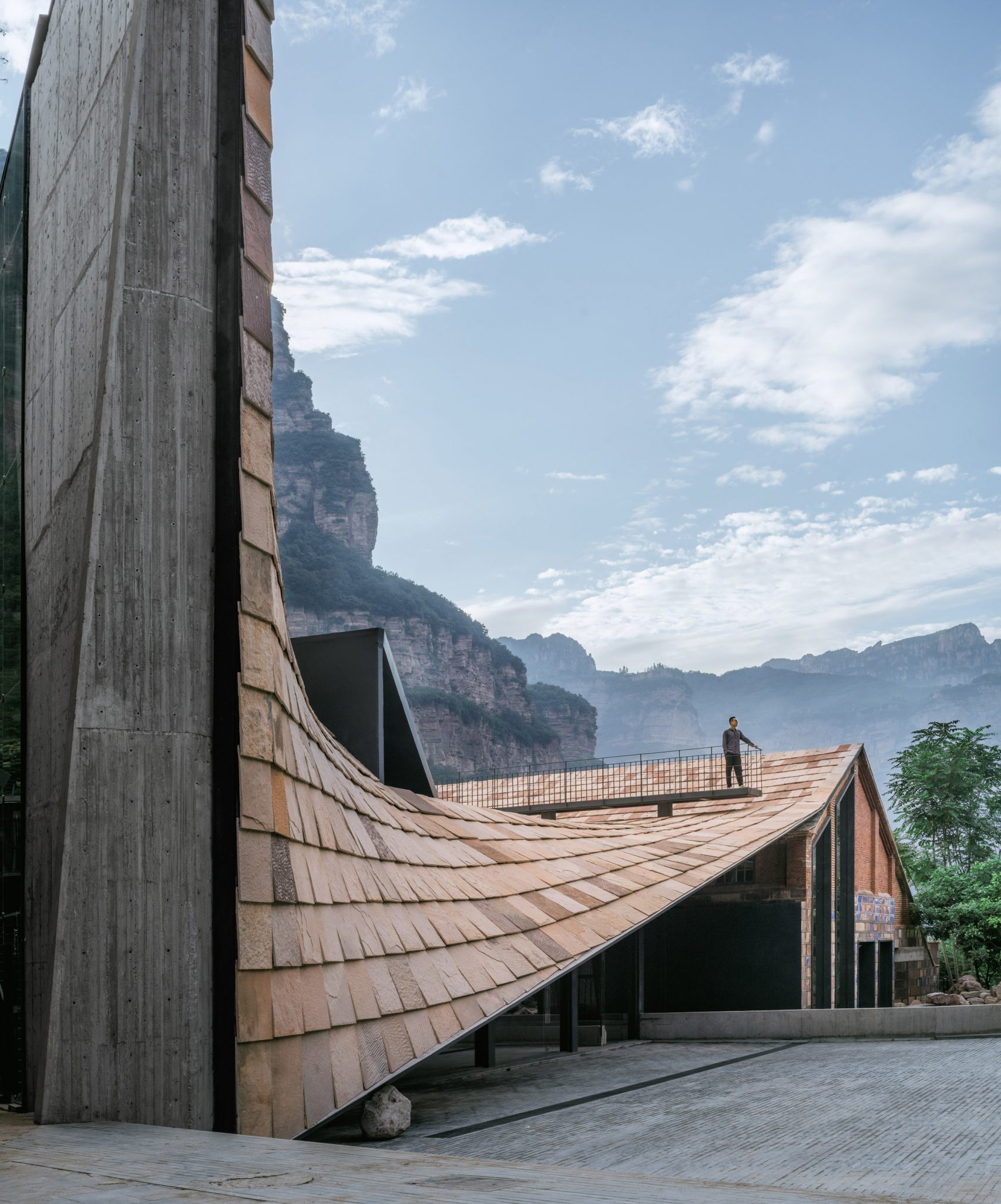
The building adopts the construction method of dry-hanging stone slabs, for which we recycled a large number of old slate slabs that were used as roofing materials for traditional houses. Old craftsmen took part in much of the construction, thus embracing the local history of craftsmanship and respecting the authentic qualities of natural materials.
Speaking of the roof, this is the other main way the designers kept the structure connected to the region. Not only do the stunning slopes of the roof remind guests of the mountainous slopes behind it, but they also pay homage to historic structures. As the Wángchōng team described, “The sloping roof draws inspiration from the Chinese-style large roof. In ancient Chinese architecture, the large roof is described as 'like a bird spreading its wings and a pheasant spreading its wings and flying', as if the wings bring a light feeling.”
The result is a stunning museum that ArchDaily describes as having “modern building materials and local sandstone materials are intertwined and stretched” to create “many landscape images (curved alleys, long bridges, folded paths, stone foundations, gazebos, caves and water walls)” where people can embrace nature and art harmoniously.
Want to see this stunning work of art and architecture for yourself? Check out a tour of the museum on STIR’s YouTube Channel.
Image sources in order of appearance: DesignBoom, dezeen and ArchDaily
About the author

Emma is the senior content developer at The Coffee Shops and AskARoofer™. When she's not working or overthinking everything a little bit, she enjoys watching movies with friends, attending concerts and trying to cook new recipes.
Recommended For You
Metal by the lake
Read More ...
Decarbonization of Industrial Building With Solar Air Heating Panels
Read More ...
Food Processing Facility Protects Employees & Customers with Roof Upgrade
Read More ...
UP TO THE MINUTE






Comments
Leave a Reply
Have an account? Login to leave a comment!
Sign In