

Roof batten compliance alert!
By The Coffee Shops®.
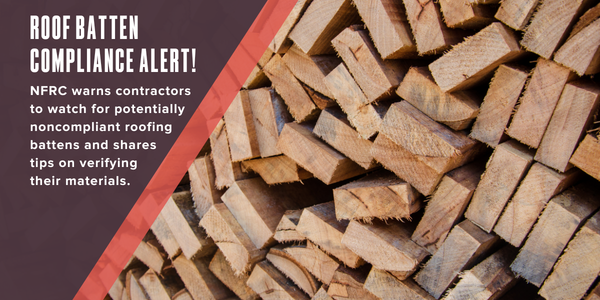
NFRC renews their warning for contractors to watch for potentially noncompliant roofing battens and shares tips on verifying their materials.
National Federation of Roofing Contractors (NFRC) is urging roofing contractors, merchants, housebuilders and the wider construction supply chain to remain vigilant after receiving photographs of roofing battens with markings that appear inconsistent with BS 5534 requirements. Although the products’ origins and the circumstances surrounding their markings have not been established, NFRC advises treating questionable battens as potentially noncompliant until their grading, documentation and traceability are verified.
Why is this such a big deal?
Roof battens are pieces of wood that are fixed to the roof deck to support roofing materials. Not only do they provide structural reinforcement of the deck, but they also help with alignment and drainage. The installation of substandard battens can negatively affect the durability and performance of a completed roof.
Further, battens are often used as footholds during roofing work when operatives are navigating between supports. A substandard batten can easily cause a devastating jobsite injury or even death if it goes unnoticed.
What installers should do
Before installation, businesses should check each batten’s dimensions, visible knots, defects and individual markings. A nominal 25 mm-thick batten should measure between 25 mm and 28 mm and must never be less than 25 mm thick. Battens should also be examined for wane, fissures, distortion, split ends, decay, insect infestation and damage caused after grading.
Once a batten is considered usable based on physical appearance, you should take time to check markings on the material. These should identify:
- The name of the supplier responsible for grading the battens, rather than only the distributor.
- The origin or timber species.
- Confirmation that the battens have been graded in accordance with BS 5534:2014+A2:2018.
- The basic size or sizes.
- The type of preservative and method of treatment, where applicable.
These markings, colour and bundle labels are a great start to ensuring your battens are safe, however they should not be accepted as proof in isolation. Delivery documentation must support the product’s grading and traceability claims.
If anything about a batten appears suspicious, NFRC recommends quarantining the material, documenting markings and defects, retaining delivery records and contacting the supplier for evidence. Concerns should also be reported to NFRC.
Learn more about identifying and managing potentially substandard roofing battens through NFRC’s Technical Bulletin TB33 and Toolbox Talk TBT01.
Learn more about National Federation of Roofing Contractors (NFRC) in their Coffee Shop Directory or visit www.nfrc.co.uk.
Recommended For You

RoofersCoffeeShop® launches RoofersCoffeeShop.global connecting roofing professionals worldwide
Read More ...
IKO Announces Plans for New Granule Facility in Missouri
Read More ...
NRCA Will Hold National Roofing Week 2020 June 7-13
Read More ...
UP TO THE MINUTE




Comments
Leave a Reply
Have an account? Login to leave a comment!
Sign In