UP TO THE MINUTE






Roofing revolution part 1: 3D printing and self-healing materials
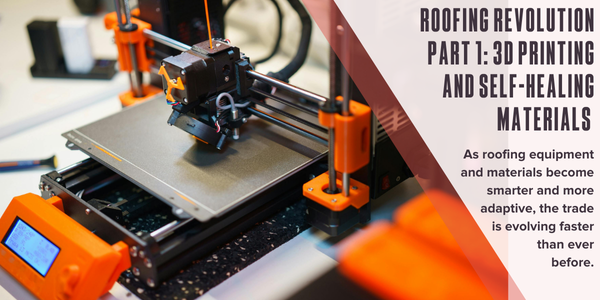
By Marco Industries.
As roofing equipment and materials become smarter and more adaptive, the trade is evolving faster than ever before.
In the ever-accelerating world of technology, change is no longer measured in centuries. While it took humanity millions of years to master fire for cooking and heating, today, everyday tools like smartphones, cloud storage and AI have quickly redefined how we live, all in the past two decades.
While industries like automotive, healthcare and aerospace often dominate tech headlines, the roofing sector is also undergoing its own revolution. New materials and advanced manufacturing techniques are beginning to reshape how we think about roof design, performance and sustainability.
In this three-part series, our team at Marco Industries will explore key innovations — starting with 3D printing and self-healing materials — that could soon transform the future of roofing as we know it.
3D printing
3D printing, or additive manufacturing, is the construction of a three-dimensional object from a CAD or digital 3D model. In the 1980s, 3D printing techniques were used primarily only to produce functional or aesthetic prototypes. Think “rapid prototyping.” By 2019, however, the precision, repeatability and material range of 3D printing increased to the point that some 3D printing processes became viable as an industrial-production technology. They could produce very complex shapes or geometries that would be otherwise infeasible to construct by hand, including hollow parts or parts with internal truss structures to reduce weight while creating less material waste.
Could this technology find its way into roofing? Absolutely. 3D printers capable of constructing entire houses, including their roofs, are being developed as you read this. In fact, they’ve already produced an entirely 3D-printed house, printed in concrete. What could that do to the possibilities for design and customization in roofing? Roofs no longer bound by traditional shapes and materials? You can bet on it.
Self-healing materials
Roofs must perform in a variety of harsh environments. They are exposed to the elements 24/7/365, without a break. That kind of wear and tear adds up. As a result, maintenance is vital to ensure the roof doesn’t become compromised. Extensive damage including granule loss, cracks, water penetration and UV degradation will diminish a roof’s performance. That’s where self-healing materials can help.
Made from thermoplastics, self-healing shingles allow for the roof itself to continuously repair small-scale scratches and wear. As the shingles heat up during the day, polymers in the thermoplastics separate, which create new bonds as the shingle cools down. This “heals” small scratches or damage to the shingle itself. Experts say that while this process can’t prevent significant damage or make the roof immune to weather conditions, it’s an exciting step towards slowing down the natural erosion of roofing elements.
Roofing has evolved tremendously over time. Early roofing relied on natural materials like animal hides, mud and vegetation. Greece and Babylon used flat earthenware roof tiles between 4,000 and 5,000 years ago. The Romans brought variations of the Greek clay tiles to England as early as 100 BC. Around 735 AD, thatched roofs were developed and used. Wood shingles were introduced 300 years later. Today, we’re seeing a whirlwind of technological advances that are impacting roofing and will have a profound effect on our industry in the years to come. Our advice: pay attention and be ready.
This is the first of a three-part series. Next up: smart roofing and cool roofing.
Original article source: Marco Industries
Learn more about MARCO Industries in their Coffee Shop Directory or visit www.marcoindustries.com.
Recommended For You

The future of rooftop piping securement
Read More ...
AccuLynx Announces New Mobile App Ahead of 2023 International Roofing Expo in Dallas
Read More ...
High value on low pitch roofs with composite slate
Read More ...
UP TO THE MINUTE
Comments
Leave a Reply
Have an account? Login to leave a comment!
Sign In