

What is the Difference Between Low-slope and Steep-slope Roofs?
By Polyglass.
All roof designs fall between these two categories, what are the unique advantages to each type of roof?
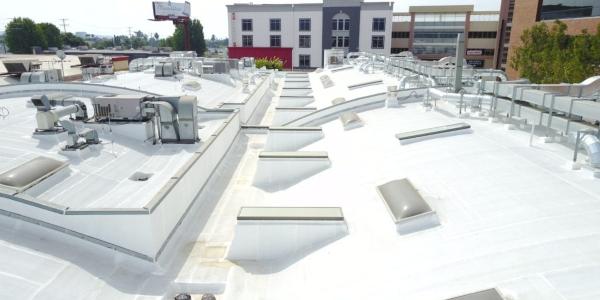
In the roofing industry “low-slope” and “steep-slope” are thrown around a lot, but what do we mean by these terms? Virtually every roof is sloped to some degree, even “flat roofs” aren’t truly flat, just slightly sloped. Slope is defined by how much the roof rises vertically for every 12 inches in length, which is expressed as a ratio of rise/12. If a roof’s elevation changed by 2 inches for every foot of length, for example, the slope is 2/12. If it rises by 4 and one-quarter inches, the slope is 4.25/12.
Low-slope roofs
What makes a roof “low-slope?” Honestly, it depends on who you ask. The Occupational Safety and Health Administration (OSHA) officially defines a “low-slope” roof as any roof with a slope of less than 4/12. However, some roofing companies define low-slope as 3/12 or less, and others 2/12 or less. (For our purposes, let’s go with the OSHA definition.)
Benefits and considerations of low-slope roofs
Low-slope roofs offer several advantages, especially for commercial buildings. First of all, low-slope roofing provides a “bonus floor” of sorts, allowing for placement of large equipment like HVAC units on the roof, and even allowing foot traffic. Low-slope roofs are also more affordable to install because they require fewer materials and involve less risk to the laborers. The tradeoff with low-slope roofs is that they must have impeccable waterproofing and must be kept free of debris to prevent water ponding and leakage.
Common types of low-slope roofs
- Built up roofs (BUR) have multiple alternating layers of asphalt and reinforcing fabric, usually with a gravel top layer
- Modified bitumen is a membrane of asphalt combined with rubber or plastic polymers, typically installed in two layers (base sheet and cap sheet)
- Single-ply roofing membranes are either rubber-based (EPDM) or thermoplastic (TPO, PVC)
Steep-slope roofs
Now let’s move on to discuss steep-slope roofs.
Sticking with OSHA’s definition, a steep-slope roof is any roof with a slope greater than 4/12. Steep-slope roofing is largely used on residential structures, but sometimes occurs on commercial buildings, as well.
Benefits and considerations of steep-slope roofs
Aside from being generally aesthetically pleasing, steep-slope roofs enjoy fairly low maintenance because rain, snow, and debris drain off of them easily. The “attic” space may also provide a heat buffer to the outside, making the building easier to heat and cool. The disadvantage is that steep-slopes create more unusable space in commercial buildings, are more expensive to install, and are more dangerous to maintain because of the roof angle.
Common types of steep-slope roofs
Asphalt shingles are by far the most common roofing material for steep-slope roofs. Metal roofing is also quite common (e.g., aluminum, copper). Clay tiles and wood shake are also common, although generally expensive.
Using Polyglass products for low-slope and steep-slope roofs
Polyglass is committed to helping professional roofing companies make the best use of our products — whether you’re working with a low-slope roof or a steep-slope roof. Don’t miss our video installation guides for low-slope roofs and steep-slope roofs.
Low-slope roofs
Polyglass offers a full range of reliable self-adhered modified bitumen products for low-slope roofs, along with high-quality underlayments, elastomeric coatings and more.
Steep-slope roofs
Polyglass offers numerous high-quality underlayment products to provide excellent waterproofing for steep-slope roofs. Watch the video below for more details.
Learn more about Polyglass in their RoofersCoffeeShop® Directory or visit polyglass.us.
Original article source: Polyglass
Recommended For You

Attendees find new ideas, connections and growth opportunities
Read More ...
MBMA Releases CEU Course: ‘Evaluating Metal Building Systems Using COMcheckTM’
Read More ...
Start spring strong with savings!
Read More ...
UP TO THE MINUTE






Comments
Leave a Reply
Have an account? Login to leave a comment!
Sign In