

When wildfire smoke reaches the roof
By Cotney Consulting Group.
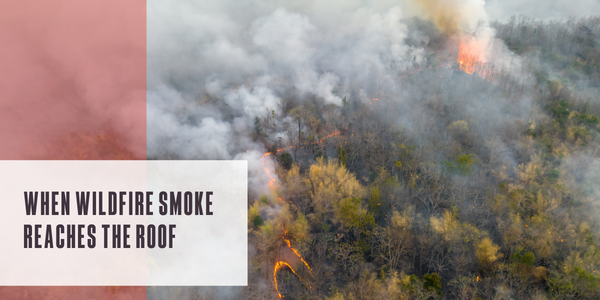
Wildfire smoke has become an operational concern that many Canadian roofing contractors can no longer treat as an uncommon event.
By mid-July 2026, hundreds of active wildfires were burning across Canada, with elevated fire danger affecting several northern and central regions. Smoke from those fires was also reducing air quality far beyond the immediate fire zones.
For roofing contractors, the impact is not limited to projects located near an active fire.
Smoke can travel hundreds or even thousands of kilometres. A roofing crew may be working under a clear-looking sky while still being exposed to unhealthy concentrations of fine particulate matter. Transportation routes can be disrupted. Employees may be affected at home. Customers may postpone work. Deliveries may be delayed. Evacuation orders can change access to an entire region with little notice.
Wildfire smoke must therefore be treated as more than a weather problem. It is a worker-safety, scheduling, documentation and business-continuity issue.
Smoke exposure is a roofing hazard
Roofing crews perform strenuous physical work in outdoor conditions. Workers climb ladders, carry materials, move equipment and install roof systems while exposed to sun, heat, wind and changing weather conditions.
Wildfire smoke adds another layer of risk.
The primary concern is fine particulate matter known as PM2.5. These particles are small enough to travel deep into the lungs and can affect respiratory and cardiovascular health. Wildfire smoke may also contain carbon monoxide, volatile organic compounds and other contaminants produced as vegetation, buildings and equipment burn.
Health Canada advises that wildfire smoke can affect health even at low levels and that air quality may be poor even when workers cannot see or smell smoke.
That point is important for roofing supervisors. The absence of a heavy visible haze does not automatically mean conditions are safe.
Employees exposed to smoke may experience coughing, throat irritation, headaches, shortness of breath, dizziness, chest discomfort or unusual fatigue. Workers with asthma, heart disease and other medical conditions may face greater risks, but healthy workers can also be affected when smoke concentrations rise.
Roofing contractors should not wait until employees become visibly ill before adjusting the work.
Monitor conditions before and during the shift
The Air Quality Health Index provides current and forecast health-risk information for communities across Canada. During wildfire-smoke events, the calculation may be adjusted to use hourly PM2.5 concentrations to reflect rapidly changing smoke conditions and their health risks.
Someone within the company should be responsible for checking the AQHI before crews are dispatched and periodically throughout the day. That responsibility should not be left to chance.
Conditions can change quickly as the wind shifts or smoke settles closer to the ground. The reading taken during the morning safety meeting may not reflect the conditions the crew faces several hours later.
Supervisors should also pay attention to local air-quality statements, evacuation alerts, road closures and emergency notices issued by provincial, territorial and municipal authorities.
The AQHI should support the contractor’s hazard assessment. Still, it does not replace the need to evaluate the physical demands of the work, individual worker exposure, local conditions and applicable occupational health and safety requirements.
Monitoring is only useful when the company has already decided how it will respond.
Contractors should establish action levels for modifying work, reducing strenuous activity, shortening shifts, increasing rest periods or suspending outdoor work. Those decisions should reflect applicable provincial or territorial occupational health and safety requirements, available public health guidance and the conditions affecting the individual project.
Canada does not have one national rule governing every roofing project. Requirements and enforcement responsibilities vary among jurisdictions. Contractors must confirm the applicable rules in the jurisdiction where the work is being performed.
Heat and smoke must be evaluated together
Wildfire smoke frequently arrives during periods of high temperature and dry weather. That combination deserves special attention.
Workers breathing faster because of heat and physical exertion may inhale more smoke. Respirators, protective clothing and other controls can also increase heat strain when improperly selected or managed.
The solution cannot simply be telling employees to work through the conditions while wearing more personal protective equipment. The contractor may need to change the work itself.
More demanding tasks can be scheduled during the best available air-quality periods. Crews can be rotated. Shift lengths can be reduced. Breaks can be increased. Workers can be provided with a clean-air or filtered recovery area away from rooftop exposure.
Water must remain readily available. Workers should be encouraged to report symptoms early, without feeling as though they are letting the crew down.
Respiratory protection may be required when exposure cannot be adequately controlled through scheduling, reduced exertion, relocation or suspension of work. When respirators are used, they must be selected for the hazard and incorporated into a properly managed respiratory-protection program. Depending on the respirator and jurisdiction, this may include worker instruction, fit testing, medical assessment, inspection, storage and replacement requirements.
A dust mask handed out at the morning meeting is not a complete respiratory-protection strategy.
Protect the roof when work must stop
Stopping work due to smoke does not relieve the contractor’s responsibility to protect the building. That is especially important when the crew has opened an existing roof or left materials, equipment and partially completed work exposed.
Every project should have a shutdown plan.
The plan should identify how the crew will secure loose materials, protect roof openings, complete temporary tie-ins, remove ignition sources and make the site weather-resistant before leaving.
Supervisors must also understand how much time is required to secure the roof. A contractor should not continue installation until the last possible minute and then discover there is not enough time to protect the building safely.
Materials and equipment may also require attention. Smoke, ash and airborne debris can contaminate roof surfaces, adhesives, insulation and stored materials. Contractors should follow the manufacturer's requirements before installing products that may have been exposed to or contaminated.
Once conditions improve, the roof should be inspected before work resumes.
The crew may need to clean surfaces, evaluate stored materials, check temporary protection and confirm that changing weather has not created additional hazards.
Document every disruption
Wildfire smoke can cause legitimate production delays, but undocumented delays often escalate into project disputes.
Contractors should maintain records of AQHI readings, air-quality advisories, local emergency notices, evacuation orders, access restrictions, work modifications, crew impacts, customer notifications, photographs, material delays and revised schedules.
Documentation should begin when the disruption occurs, not weeks later when someone asks why the project is behind schedule.
Contracts may contain notice requirements for delays, changed conditions, emergencies or events outside the contractor’s control. Those requirements often include strict deadlines and specific methods of notification.
Wildfire conditions should not automatically be assumed to qualify as force majeure or guarantee additional compensation. The contract language, facts and jurisdiction will determine the parties’ rights and responsibilities.
Contractors should review significant contractual or insurance questions with qualified Canadian legal and insurance professionals. The project manager’s responsibility is to create a clear and timely record.
Expect secondary operational effects
A project does not need to be in an evacuation zone to be affected by a wildfire.
Road closures and emergency restrictions may change delivery routes. Employees may be unable to report due to their families' or communities' being affected. Suppliers may experience interruptions. Hotels and temporary accommodations may be occupied by evacuees or emergency personnel. Fuel availability and transportation schedules can change.
The contractor should review upcoming work and identify where one disruption could affect multiple projects.
- Are critical materials being shipped through an affected region?
- Are alternate suppliers available?
- Can deliveries be moved forward?
- Does the company have another qualified crew that can support the project?
- What happens if a project manager, superintendent or key operator becomes unavailable?
- Which customers must be notified first?
The purpose is not to predict every possible outcome. It is to identify the few failures that could stop the company from operating.
Build wildfire response into the company plan
Emergency planning is often focused on what happens at the jobsite. Wildfire conditions require a broader view. The company’s plan should address workers, projects, vehicles, records, technology and customer communication.
Emergency contact information should be current. Employees should know how the company will communicate when normal operations are interrupted. Project records should be accessible remotely. Important documents should be backed up. Managers should know who has authority to suspend work, move crews, authorize emergency purchases and communicate with customers.
Contractors operating in higher-risk areas should also consider how they will respond after the immediate emergency.
Demand for temporary repairs and restoration work may rise quickly. Existing customers may need priority service. Building owners may request inspections before contractors have sufficient labour available to respond.
That demand can look like an opportunity. It can also overwhelm a company.
Roofing contractors should resist accepting more emergency work than they can safely inspect, document, schedule and complete. Overcommitting during a regional event leads to rushed decisions, poor communication, quality failures and unpaid work.
The contractor’s first responsibility is to protect its people and to uphold its existing obligations.
Leadership matters most when conditions change
No policy can account for every smoke event, fire location or project condition. Someone still has to make the decision.
Good supervisors recognize when the original plan no longer fits the conditions. They listen when workers report symptoms. They understand that stopping for safety is not a failure of production management.
It is production management.
Roofing companies cannot control where wildfires occur or where the smoke travels. They can control whether they monitor the conditions, prepare their supervisors, protect their workers, document disruptions and communicate with their customers.
Wildfire smoke is now part of the operating environment for many Canadian contractors. The companies that prepare for it will protect more than a day’s production. They will protect their workers, their projects and their ability to keep operating when conditions change.
Learn more about Cotney Consulting Group in their Coffee Shop Directory or visit www.cotneyconsulting.com.
Recommended For You
What You Should do to Storm-prep Your Jobsite
Read More ...
The impacts of an El Niño
Read More ...
Delivering architectural flexibility and dependable weather protection
Read More ...
UP TO THE MINUTE





Comments
Leave a Reply
Have an account? Login to leave a comment!
Sign In