UP TO THE MINUTE






An Efficient Roof for All Seasons
By Cass Jacoby, RCS Reporter.
All-season smart roof coating technology uses physics to make roofs warmer in the winter and cooler in the summer.
Cool roofs that have reflective coatings, membranes, shingles or tiles have been all the rage when it comes to energy efficiency. These systems work by reflecting back sunlight in a natural process known as radiative cooling. The one caveat of this efficient roof system being that these cool roofs continue to radiate heat away and cool the home in the winter.
However, homeowners might no longer need to choose between a cool roof and higher heating costs with a new breakthrough technology: temperature-adaptive radiative coating (TARC).
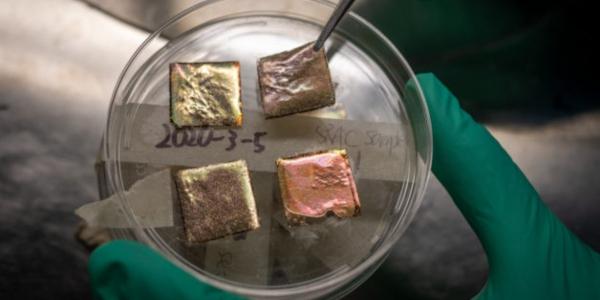
The temperature-adaptive radiative coating looks like Scotch tape and can be affixed to the roof, and, like magic, stays cool in hot temperatures and insulates in colder temperatures.
“TARC can enable energy savings by automatically turning off the radiative cooling in the winter,” faculty scientist in Berkeley Lab’s Materials Sciences Division and a UC Berkeley professor Junqiao Wu told the Sierra Sun Times. So how does this magic new roof coating work?
Back in 2017, Junqiao and his research team discovered that electrons in vanadium dioxide behave like a metal to electricity but an insulator to heat – in other words, they material can phase-change and go from insulator to a metal.
Vanadium dioxide below 153 degrees Fahrenheit is also transparent in (and hence not absorptive of) thermal-infrared light. But once vanadium dioxide reaches 153 degrees Fahrenheit, it switches to a metal state, becoming absorptive of thermal-infrared light.
You may be thinking that 153 degrees is a pretty high temperature for a roof, but Junqiao and his colleagues have found that adding tungsten to vanadium oxide helps drop the compounds phase-switch point to 77 degrees Fahrenheit. Thus, the material makes for “energy-free, emission-free air conditioning and heating,” Junqiao told Science Daily.
Research findings reported in the journal Science point to TARC roof coating as a better alternative option to commercial cool-roof systems, since the material can overcome the problem of overcooling. “The whole point of our work is that our roof works not only in hot weather, but also in cold weather,” Junqiao told Popular Science.
The coating works especially well for climates where temperatures swing between hot summers and cold winters, according to the simulations. The material saved more energy than existing roof coatings in 12 of the 15 climates they simulated within the study. “With TARC installed, the average household in the U.S. could save up to 10% electricity,” co-author of the study and assistant professor at Peking University Kechao Tang told the Sierra Sun Times.
Junqiao plans on patenting the material this year and is looking for more ways to make more vanadium oxide efficient. “We are looking into improving the performance, while making it scalable,” he tells Popular Science.
With greater efficiency in both warm and cold climates, on top of the material's lack of emissions or energy, it might not be too long before we see temperature-adapting roofs as an option for homeowners to green their energy bill.
Stay up to date with the latest roofing industry news when you sign up for the RCS Week in Roofing e-news.
Photo credit: Thor Swift/Berkeley Lab
Recommended For You

Cool Roof Rating Council Celebrates 25 Years of Making Roofs Greener
Read More ...
S-5! Launches New Solar Calculator
Read More ...
Roofing Goes Green
Read More ...
UP TO THE MINUTE
Comments
Leave a Reply
Have an account? Login to leave a comment!
Sign In