UP TO THE MINUTE






Project profile: Cato-Meridian Schools

By Carlisle SynTec Systems
Learn why this New York school put their trust in Carlisle’s FleeceBACK® EPDM.
In upstate New York, due East of Rochester, sits a town called Cato. This picturesque town is over two hundred years old and is known for “scenic, rolling drumlins separated by tranquil lakes, ponds and streams.” The community there is also known for its rich history of academic excellence, dating back to the 1930s. Today, they have a diverse population of over 800 students between the local elementary school (originally built in 1939) and the junior-senior high school (built in 1967). Both of these buildings have seen significant additions and improvements over the years (the elementary school got additions in 1957 and 1966 where the high school had an addition in 2004).
In 2023, the Cato-Meridian Central School District in New York undertook a sweeping infrastructure improvement project to provide their students with better facilities and opportunities. Within the scope of the $33 million project was reroofing the elementary and high schools. When it came time to choose a product to put on the roof, they chose Carlisle Syntec System’s FleeceBACK EPDM. Keep reading to learn about the process of these reroofs and why that was the perfect system for the job.
The roofs on both schools were getting by with C-grades
The fully adhered EPDM roofing systems on both schools were still functional although infrared scans of both roofs showed some areas of moisture, despite overall good drainage from the roof. “Since the roofs on both schools were serviceable, we originally planned to coat the roofs with a reinforced coating system,” said Roger VandePoel of Tetra Tech Architects and Engineers of Ithica, New York. “But that changed after we reviewed all the proposals and evaluated the costs and long-term roofing performance.”
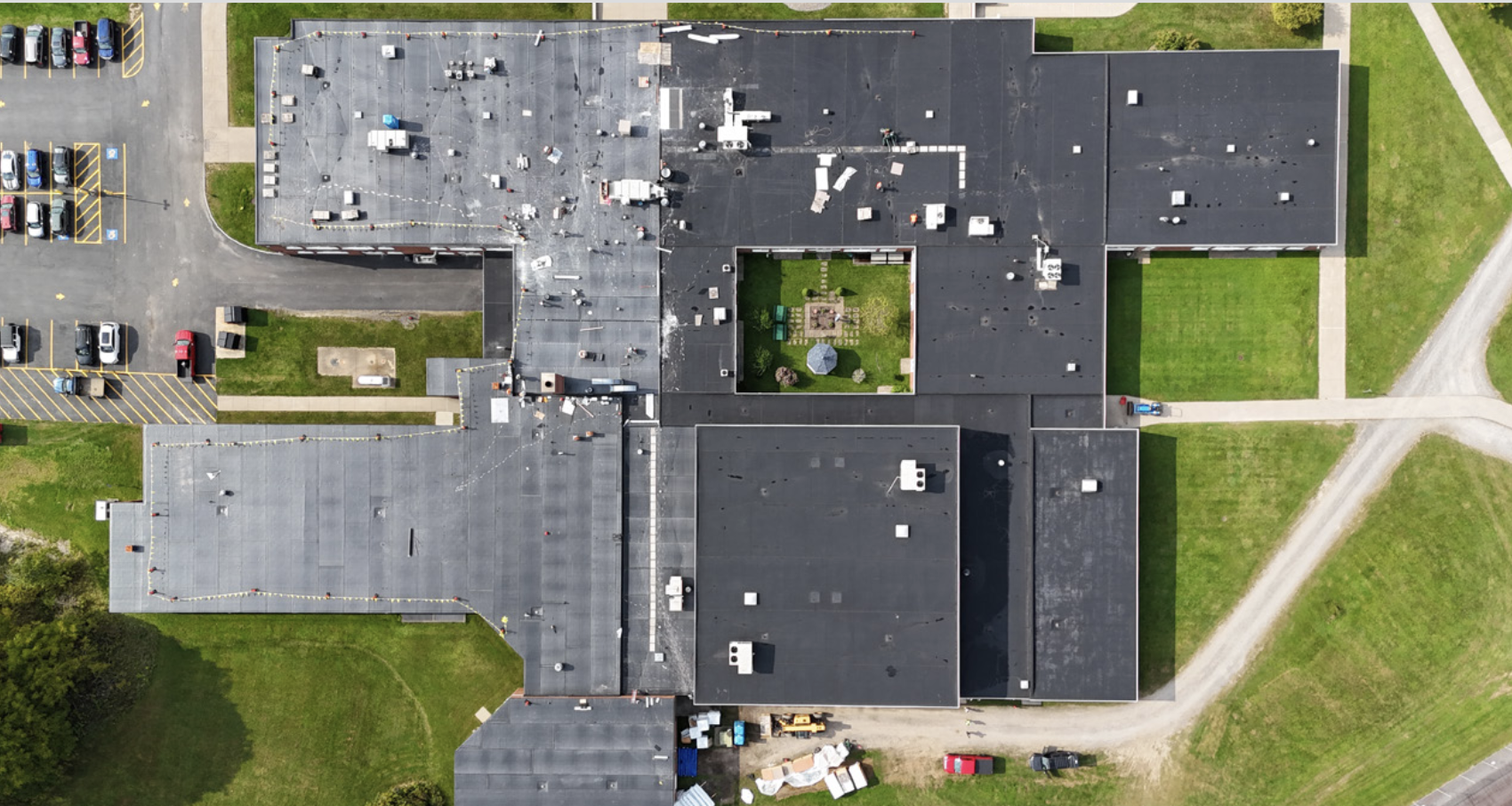 Instead of a reinforced coating system, the decision was made with the school district to proceed with a Carlisle SynTec Systems FleeceBACK EPDM system installed directly over the existing membrane on both buildings.
Early in the project Tetra Tech reached out to Cannan Alexander & Scott (CAS), independent Carlisle representatives in upstate New York. That was fortuitous because CAS has deep experience working with both types of systems and was able to recommend EPDM for this project due to its long history of great performance.
“After talking with Cannan Alexandar and Scott (CAS), Carlisle’s Manufacturer Representative in NY and conducting a detailed analysis of both options, we decided that the 20-year Carlisle Sure-SealFleeceBACK EPDM overlay system was the best choice in terms of cost effectiveness, performance, long-term maintenance costs, and compatibility with the existing roof material,” said Roger.
CJ Marly Construction of Marcellus, New York, was hired for the roofing work. The company has been a Carlisle Authorized Applicator for more than 20 years and has a great reputation in the local market for outstanding work. The roofing work included a total recover of the junior-senior high school, which totaled 85,900 square feet of roofing, and recovering approximately half of the elementary school or about 46,000 square feet. The other half of the elementary school roof, a fully adhered Carlisle EPDM system installed by CJ Marly Construction in 2017, was still in great shape, under warranty and did not need to be replaced.
The highest priority for the project was to ensure the safety of the students, teachers, and staff, as the roofing work would be completed while school was in session. The assembly on that portion of the roof included Carlisle’s VapAir Seal™ 725TR, R-30 flat and tapered polyiso insulation covered with ½-inch SecureShield® HD Polyiso cover board, installed using Carlisle’s Flexible FAST™ Adhesive, followed by a fully adhered 60-mil Sure-Seal® EPDM membrane installed with Carlisle’s CAV-GRIP® Adhesive.
“Safety was of course our top priority. We took steps to make sure that the staging area and access to the roof were as isolated as possible from the students and staff,” said Chris Farnett, president of CJ Marly Construction. “The staging area and access to both roofs were set up on the back side of the schools and out of view of the students and staff. We also fenced off the staging yard and loaded the roof only after the students were already inside the building. We didn’t have any issues with anyone getting too close to the site or our equipment, and most of all, everyone stayed safe.”
Roofing recover work
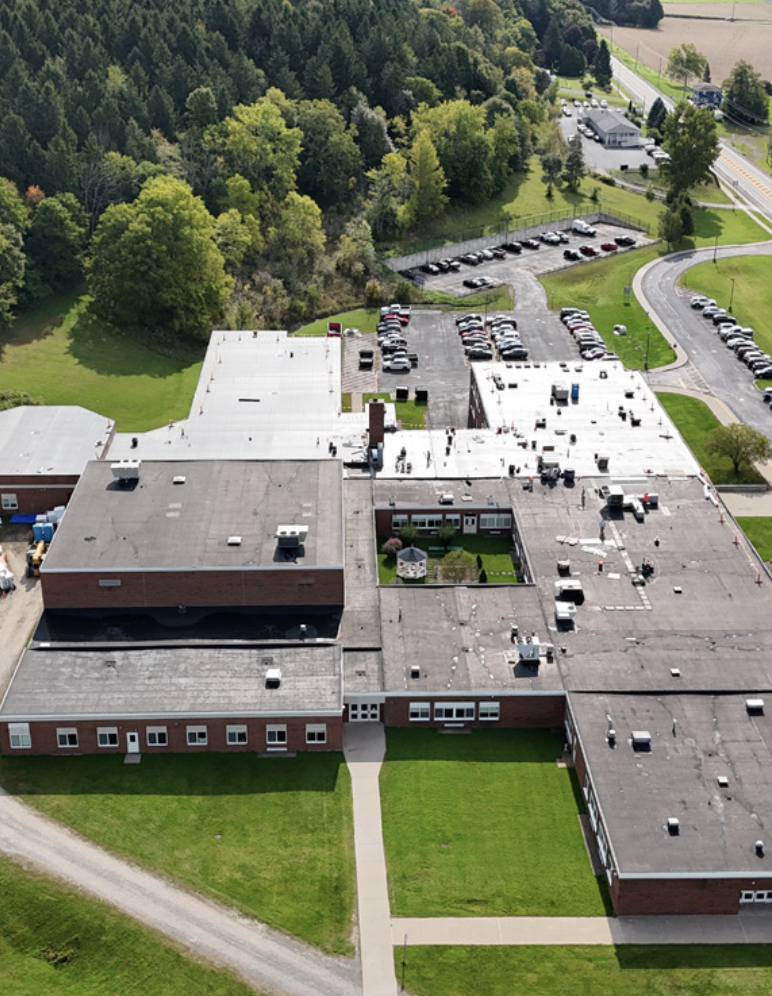 The junior-senior high school roof is divided into about a dozen sections and five different levels. The two-story brick building has a small center courtyard in the center of the building, as well as a raised ‘penthouse’ structure at the rear of the building. Three of the building’s corners have extensions or ‘wings,’ coming off the main structure, and there’s a six-sided hexagon-shaped structure at the back of the building. The roof includes several AC units on curbs, lots of exhaust vents and several other small penetrations that all needed to be properly flashed. Several sections of the roof are divided by low knee walls.
The older elementary school, located across a few athletic fields, features an iconic front façade with a portico over the door supported by four large columns and a high-slope roof adorned by a bell tower. The two-story brick building rambles back and to the left and the roof is divided into nine or ten sections and four different levels.
Again, some small knee walls divide the roof sections and there were a handful of penetrations on this portion of the roof, including several new air handling units, that had to be flashed. The first step for both buildings was to clean the existing EPDM roof with a light power wash and allow it to dry. “Roofs tend to accumulate lots of dirt and debris that does not wash off in the rain, so it was important to get the membrane as clean as possible for the new roof,” said Chris.
The next step was to cut holes in the existing membrane every 100 square feet to let the assembly breathe, and to remove the existing edge metal, vertical flashings and all wet or damaged roof insulation and components down to the structural deck. “The deck on the high school was steel,” said Chris, “but on the elementary school there were four different deck types including concrete, gypsum, tectum and terra cotta. So, we had to address each deck type differently.”
The wet areas that were removed down to the structural deck had to be rebuilt in all cases back up to the level of the existing roof. “Replacing the roofing components where we cut out the wet materials required us to install a vapor barrier, ½-inch SecureShield HD Polyiso cover board, and flat and tapered insulation to match the existing level of the roof,” said Chris. “Some of that work was tricky because the roofs both have a series of internal drains, so we had to match two-, three-, and four-way tapers for the drainage.”
Once the wet materials and a few old mechanical curbs that were no longer needed were removed and replaced, the roofing membrane could be installed. For this, the CJ Marly crew rolled out the 10' rolls of 115-mil Sure-Seal FleeceBACK EPDM. The membrane comes with Factory-Applied Tape™ for consistent, high-quality seams and offers superior wind, puncture and hail resistance.
“The Factory-Applied Tape helps the installation process move along, and our crew really likes using the FleeceBACK membrane with Flexible FAST Adhesive,” said Chris. Flexible FAST Adhesive, a two-component urethane adhesive that is VOC-free and resistant to impacts, is designed for use with FleeceBACK membranes. The CJ Marly team applied the adhesive in beads spaced four inches on center, then laid down the membrane and rolled it in using a 150-pound segmented roller to ensure that the fleece fibers were fully embedded into the adhesive. A short while later, the Flexible FAST Adhesive had already formed a tenacious bond between the membrane and the substrate.
“We can apply Flexible FAST without disrupting the faculty, staff or students,” said Chris. “There’s virtually no noise or odors associated with the system, so it’s an ideal solution when you have an occupied building like we had with these two schools.” Both roofs were terminated using new canted gravel stop fascia that CJ Marly bent using Peterson PAC-CLAD Aluminum to meet ES-1 requirements. The knee walls between sections of the roof were covered with Carlisle’s 60-mil Sure-Seal® EPDM.
“One of the things that we really liked with this option was that we had new edge metal flashing,” said Roger. “The coating system would not have provided that and many roof failures start at the edge due to improper termination. In fact, a microburst peeled back part of the roof several years ago due to a poor edge detail, so getting a new edge system was important.”
One other critical component of the project should be noted. The roofing project was procured through The Interlocal Purchasing System (TIPS), a national purchasing cooperative that provides access to competitively procured purchasing contracts to its members. The program provides several benefits to members, including simplified purchasing, time savings, more control over the project and the opportunity to invite preferred contractors to participate. The TIPS program greatly assisted the overall roofing project and helped the Cato-Meridian Central School District save almost $400,000 and get a premium roof that will last for many years.
On this project, Carlisle’s FleeceBACK EPDM system was not only a more economical solution, but it also offers a tough new edge metal system, better wind uplift protection, superior puncture and hail resistance and the tried-and-true performance of EPDM membrane. For that, the project gets an A+, and the participants are sent to the head of the class.
Original article and photo source: Carlisle SynTec Systems
Learn more about Carlisle SynTec Systems in their Coffee Shop directory or visit www.carlislesyntec.com.
Recommended For You

Villa’s High-slope Roof Redirects Rainwater Into Reservoir
Read More ...
Custom ATAS Panels adorn award-winning project and historic U.S. National Landmark
Read More ...
Carlisle’s 16' Sure-Weld TPO and RhinoBond System boost performance at Floor & Décor
Read More ...
UP TO THE MINUTE

Comments
Leave a Reply
Have an account? Login to leave a comment!
Sign In