UP TO THE MINUTE





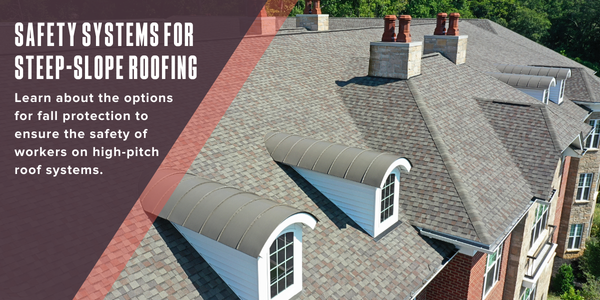
Safety systems for steep-slope roofing
By Matt Savin, Florida Roofing and Sheet Metal Contractors Association, Inc. (FRSA).
Learn about the options for fall protection to ensure the safety of workers on high-pitch roof systems.
Steep-slope roofing, with its water and snow shedding benefits and strong curb appeal, also presents unique safety challenges that require close attention to meet fall protection requirements. Defined by OSHA as any roof with a pitch exceeding 4:12, steep-slope systems are common on residential homes and many commercial buildings. Regardless of roof covering or structure type, OSHA applies the same fall protection standards across all steep-slope systems. Here at The Florida Roofing and Sheet Metal Contractors Association Inc. (FRSA), we want contractors to understand these regulations to remain compliant and protect workers on every jobsite.
Available fall protection options for steep-slopes
While there are fewer choices for steep-sloped roofing than for low-sloped surfaces, fall protection is still required whenever work is being performed. The most common options include:
Guardrail systems
Guardrail systems must include:
- A top rail positioned 45 inches, give or take three inches, above the walking surface.
- A midrail and toe board.
- Structural integrity capable of withstanding a 200-pound force in any direction.
- Smooth construction to prevent injury from sharp edges or protrusions.
Safety net systems
Though it is not common on roofing projects, safety nets can be highly effective. They must:
- Be installed as close as possible to the work area, never more than 30 feet below.
- Provide sufficient clearance to prevent contact with structures or objects beneath.
- Be drop-tested with a 400-pound weight upon installation, relocation or every six months.
- Have all caught debris removed promptly – no later than the start of the next shift.
Personal Fall Arrest Systems (PFAS)
FAS is often the most common — but also the most frequently misused — form of fall protection. A complete system includes:
- Full-body harness: It must fit properly and be fully secured to prevent an employee from slipping out in the event of a fall.
- Lanyard: Connects the harness to the horizontal lifeline, adjusted to minimize fall distance. OSHA limits free falls to six feet.
- Horizontal lifeline: Must have a breaking strength of at least 5,000 pounds and attach to the anchor with a double-locking snap hook.
- Anchorage point: Rated for a minimum of 5,000 pounds per person. Multi-user anchors exist but are less common and standard single-user anchors should only support one worker at a time. Proper installation with the manufacturer’s specified fasteners or equivalent is required.
Final note
While each option has advantages and limitations, the selection should be based on the specific jobsite conditions, roof design and task requirements. Proper training, inspection and installation are essential for ensuring compliance and worker safety. For more specific information, visit www.osha.gov/fall-protection.
Original article source: FRSA
Learn more about Florida Roofing and Sheet Metal Contractors Association (FRSA) in their Coffee Shop Directory or visit www.floridaroof.com.
Recommended For You
How to Spot an OSHA Inspector Impersonator
Read More ...
Clean sites prevent falls and fines: Housekeeping essentials for roofing crews
Read More ...
The roofing safety blueprint
Read More ...
UP TO THE MINUTE
Comments
Leave a Reply
Have an account? Login to leave a comment!
Sign In