

Stop the snap: Hose whipping hazards on roofing sites
By Cotney Consulting Group.
Roofing crews who take hose safety seriously work faster, cleaner and with fewer surprises.
Roofers work with compressed air and fluid hoses every day, from pneumatic nail guns and spray rigs to compressors and cleaning tools. These hoses make the job faster and more efficient, but they can also become dangerous in an instant.
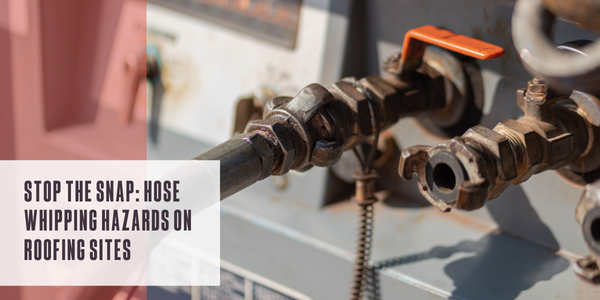
When a pressurized hose disconnects or a fitting fails, it doesn’t simply drop; it snaps and whips with violent force. A ½-inch air hose at 120 psi can lash out with hundreds of pounds of energy, swinging metal fittings fast enough to break bones or cause serious head and eye injuries.
Hose whipping accidents happen fast and almost always without warning. The good news? They’re 100% preventable when you understand the risks, maintain equipment and follow safe handling procedures.
Understanding the power of pressure
Compressed air and fluid lines are standard tools on modern roofing jobsites, especially for large-scale production crews. Nail guns, spray adhesives, pressure washers and liquid systems rely on steady, high-pressure connections. The problem arises when that pressure escapes uncontrollably.
A disconnected or ruptured hose instantly becomes a flexible projectile. If the coupler, clamp or fitting lets go, the energy stored in that hose is released immediately. The result is a whipping motion that can reach several feet in every direction. Workers nearby have no time to react; the heavier the fitting, the greater the damage it can cause.
This is not a minor hazard. Hose-whip injuries have caused fractured wrists, concussions and even fatalities. Supervisors should treat hose restraint and inspection the same way they treat fall protection non-negotiable.
Inspect before you connect
Inspect all hoses and fittings every day before use. Look for cracks, bulges or soft spots in the rubber. Check for damaged threads, bent couplers or missing safety pins. A small air leak might seem harmless, but it’s often the first sign that pressure is working against a weak connection.
When you find damage, tag and remove the hose from service; do not tape over cracks or leaks. Tape hides problems and gives a false sense of security. If a hose or fitting looks questionable, replace it. A new hose costs nothing compared to an injury or lost work time.
If you’re using multiple hoses connected, ensure each section is rated for the system’s maximum pressure and that all fittings match in type and thread size. A mismatched coupling can fail even if everything else looks fine.
Secure it right — Safety cables save lives
Every pressurized hose should have whip-check cables or restraint systems installed at both ends. These flexible steel cables attach between the hose and the equipment, preventing the line from flailing if the fitting blows. Inspect restraint cables just like you would inspect the hose. If you see corrosion, fraying or broken strands, replace them immediately. A damaged safety cable is no better than none at all.
Keep extra whip-checks in your job box, and ensure new hires know what they’re for. If a hose is pressurized, it needs a restraint period.
Control the pressure before disconnecting
One of the most common causes of hose-whip injuries is disconnecting lines that are still under pressure. Before servicing or detaching any hose, always shut down the air or fluid supply at the source and bleed off residual pressure. Use a controlled release valve if the equipment has one. Never assume a hose is empty just because the tool has stopped running. Trapped pressure can linger. And never “crack” a fitting open to release air manually. That’s a recipe for injury.
Workers should follow the same basic principle in lockout-tagout systems: isolate, release and verify. Only then is it safe to disconnect.
Stay clear of the line of fire
Stand to the side when connecting, disconnecting or testing a pressurized hose that is not directly in line with the fitting. Keep coworkers out of the area, too. If a connection fails or bursts, it will move outward in the same direction as the hose path.
If work requires multiple people handling a line, coordinate your movements. Communication prevents surprises, which cause injuries. Never point or drag a pressurized hose toward another worker, even momentarily. Please treat it with the same respect you would a loaded nail gun.
Store hoses the right way
When the workday ends, how you store hoses determines how long they last. Coil them neatly without kinks, and hang them on reels or dedicated hooks, not nails, scaffolding or around sharp edges. Avoid leaving hoses in the sun, across gravel or near heat sources.
A hose left under tension, twisted or stepped on day after day will eventually fail when you least expect it. That failure usually happens when it’s under pressure.
Train every crew member
Most hose-whipping injuries happen to newer or untrained workers who haven’t seen one let go. Don’t wait for a scare to drive the lesson home. Include hose inspection and restraint in every orientation and safety talk.
Show a short video or a low-pressure example during training to demonstrate what happens when pressure is released. Once a roofer sees that force in action, they’ll respect it. Make it part of your daily checklist alongside PPE and fall protection.
Supervisors should also enforce consistency. A missing safety cable, a hose lying across a walkway or a coupler showing wear isn’t just bad housekeeping; it’s a hazard waiting to happen.
Prevent the whip before it starts
Hose whipping isn’t an accident; it’s a consequence of neglect. The equipment gives warning signs: loose fittings, minor leaks or worn restraints. Please pay attention to them.
Securing every connection, depressurizing before disconnecting and keeping people clear of active lines are basic, repeatable habits that prevent major injuries. Roofing crews who take hose safety seriously work faster, cleaner and with fewer surprises.
In short, control the pressure, don’t let it control you.
Learn more about Cotney Consulting Group in their Coffee Shop Directory or visit www.cotneyconsulting.com.
Recommended For You
Making safety a part of company culture
Read More ...
Three Tips for Reducing Lightning Risks
Read More ...
Low-Slope Roofing Mistake No. 2: Not Cleaning the Membrane
Read More ...
UP TO THE MINUTE





Comments
Leave a Reply
Have an account? Login to leave a comment!
Sign In