UP TO THE MINUTE







A Burning Question is Finally Answered
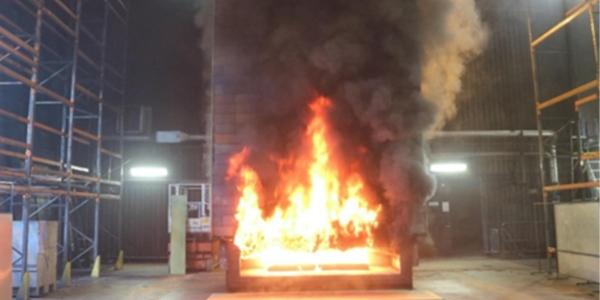
By National Slate Association.
Does slate burn? A question seared into minds and requires investigation.
Recently, I’ve had a burning question. Literally. When wood is set on fire, it creates a chemical reaction that can be seen as smoke. Many objects are easily set aflame. But what about rocks? More specifically, slate? Does it produce any chemical compound such as gas or toxins? Does slate burn?
So, why is this question in the spotlight?
Due to the increase of gigantic, violent fire events we are experiencing as a result of the global warming (or climatic change), authorities, architects and the general public are paying very much attention to how materials used in construction respond to fire. We have seen entire towns completely reduced to ashes in California, and unfortunately, in the following years this is very much likely to be repeated.
This concern is fully justified. Until now, some companies and the National Slate Association have commissioned tests to different testing laboratories. However, since there is not a specific standard for roofing slates, results have a certain margin of uncertainty which could be used in a hypothetical legal trial. Do not miss out that, in the worst scenario, insurance companies would appeal anything in order not to take charge of a possible compensation…even that the roofing slate installed was responsible of the fire. Therefore, we need absolute evidence that cannot be disputed.
Nowadays, science is communicated through the scientific journals which are indexed in a database named Web of Science. All papers published in these journals are subjected to peer review, which assures that other scientists from the same field of knowledge review and detect any incongruity in the papers. Therefore, papers published in these journals are accepted as scientific evidence.
Taking into account the possible legal implications and knowing that this work should be clear and undeniable, other colleagues and I performed a set of scientific tests on different types of roofing slates. In other words, we submitted slates to temperatures up to 900 °C (or 1650 °F if you prefer) and observed what happened.
Not so much, really.
All slates became reddish, as expected, since fire is one of the most powerful oxidant processes we know. The bending strength diminished and they became more brittle. This result was also expected. Besides, we monitored the mineralogical and chemical changes held during fire exposure. Tests were held at the Universities of Ghent, Belgium, and Oviedo, Spain. Nothing more happened besides these two effects, color change and loss of mechanical resistance. No hazardous gases, nor the release of any damaging substance, and of course, none of the samples burned. They all just got very hot.
We could have continued the test until melting of the slates, but nothing else would have happened. Slate does not burn. You can tell it to the insurance company. Check it by yourself, the paper is available at www.authors.elsevier.com.
Learn more about National Slate Association (NSA) in their Coffee Shop Directory or visit www.slateassociation.org.
Original article source: Be Natural
Recommended For You
Chimney Tuckpointing: Do’s and Don’ts for Selecting Mortar
Read More ...
Haciendo de los collars para tubería un estándar
Read More ...
Modernizing how roofers find crews
Read More ...
UP TO THE MINUTE
Comments
Leave a Reply
Have an account? Login to leave a comment!
Sign In